
You're getting traffic. People are landing on your store, browsing your products, and then... leaving. No sale. No sign-up. Nothing. This is exactly where ecommerce CRO services come in. Instead of pouring more money into ads, conversion rate optimization helps you make the most of the visitors you already have.
It's about turning browsers into buyers, without increasing your ad spend by a single dollar.
This guide covers everything you need to know about ecommerce conversion rate optimization services, from how they work to what they cost and how to pick the right one for your store.
Ecommerce CRO services are data-driven strategies and expert-led processes that increase the percentage of your website visitors who complete a purchase, sign up, or take another desired action.
Think of your online store as a physical shop. Imagine hundreds of people walking through your door every day, picking up products, and then quietly slipping out before reaching the cash register. You wouldn't ignore that. You'd figure out what's stopping them. That's what CRO does, but for your e-commerce site.
The average ecommerce conversion rate sits between 1.5% and 3.5%, depending on your industry. If you're below that, you're leaving real money on the table. And even if you're within that range, there's almost always room to improve.
Here's the key difference between CRO and paid traffic strategies. SEO and ads bring people to your store. CRO makes sure they actually buy once they're there. One fills the funnel, the other fixes the leaks. Both matter, but most ecommerce businesses overfund traffic and underfund conversion.
Working with a professional CRO service means you get a team that runs tests, reads user behavior, spots friction points, and knows how to remove them. The result? More revenue from your existing traffic. That's a compelling return on investment.
A full-service ecommerce CRO offering typically includes A/B testing, checkout flow optimization, UX improvements, behavior analytics, and personalization. Together, these components cover every stage of the customer journey.
These aren't separate services you pick from a menu. The best ecommerce CRO services combine them into a connected strategy where each component informs the next.
A/B testing compares two versions of a page to see which one converts better. You might test two different headlines, button colors, or product image layouts. Multivariate testing goes a step further and tests multiple variables at once. Both methods give you hard data instead of gut feelings. Good CRO agencies run hundreds of these tests to build a clear picture of what your specific audience responds to.
Cart abandonment is one of the biggest conversion killers in ecommerce. Research consistently shows that checkout friction, including too many form fields, forced account creation, and surprise costs, drives customers away right at the finish line. Checkout optimization streamlines this process. It reduces the number of steps, enables guest checkout, and introduces localized payment options that make buying feel seamless.
Your UX design directly affects how visitors feel and behave on your site. Confusing navigation, unclear CTAs, and poor mobile layouts all lower conversion rates. CRO services refine these elements based on real user behavior data, not assumptions. Better CTAs, cleaner layouts, and intuitive flows make it easier for visitors to say yes.
Heatmaps show you exactly where visitors click, scroll, and hover. Session recordings let you watch real user sessions to see where people hesitate or drop off. These tools are essential for understanding user behavior at a granular level. Without them, you're guessing. With them, you have a roadmap of exactly where your funnel is losing people.
Not every visitor to your store is the same. A first-time visitor needs social proof and trust signals. A returning customer might respond better to loyalty rewards or upsell offers. CRO services use personalization to match on-site messaging to specific audience segments, which significantly improves ecommerce conversion rates across the board.
Ecommerce CRO services follow a structured process: audit your store, analyze user behavior, form hypotheses, run tests, and implement what works. This cycle repeats continuously to drive compounding conversion improvements.
It's not a one-time fix. It's a process. Here's what that looks like in practice.
Every good CRO engagement starts with a full audit. The team reviews your analytics, identifies where visitors are dropping off in the funnel, and benchmarks your current conversion rates. This gives you a clear starting point so you can measure actual progress.
Next comes a deep look at your conversion funnel. Where exactly are people leaving? Is it the product page? The cart? The checkout? User research, including surveys, heatmaps, and session recordings, adds the "why" behind the numbers. This stage is where CRO specialists often surface surprising insights that no amount of traffic data alone would reveal.
Once you know what's broken, you build hypotheses. "If we remove the account creation requirement at checkout, cart abandonment will drop." That's a testable, measurable hypothesis. A strong CRO team builds dozens of these and prioritizes them by potential impact and ease of implementation.
This is where A/B tests and multivariate tests go live. You need enough traffic and enough time to collect statistically significant results. Calling a winner too early is one of the most common and costly CRO mistakes. Most agencies recommend a testing period of at least two to four weeks per test. Expect initial actionable insights to emerge within 6 to 12 weeks of starting a CRO engagement.
When a variation wins, it gets implemented. But the work doesn't stop there. Each winning test raises new questions and opens new opportunities. The best CRO programs are iterative, meaning every round of testing builds on the last. Over time, the gains compound and you end up with an ecommerce store that converts far better than it did when you started.
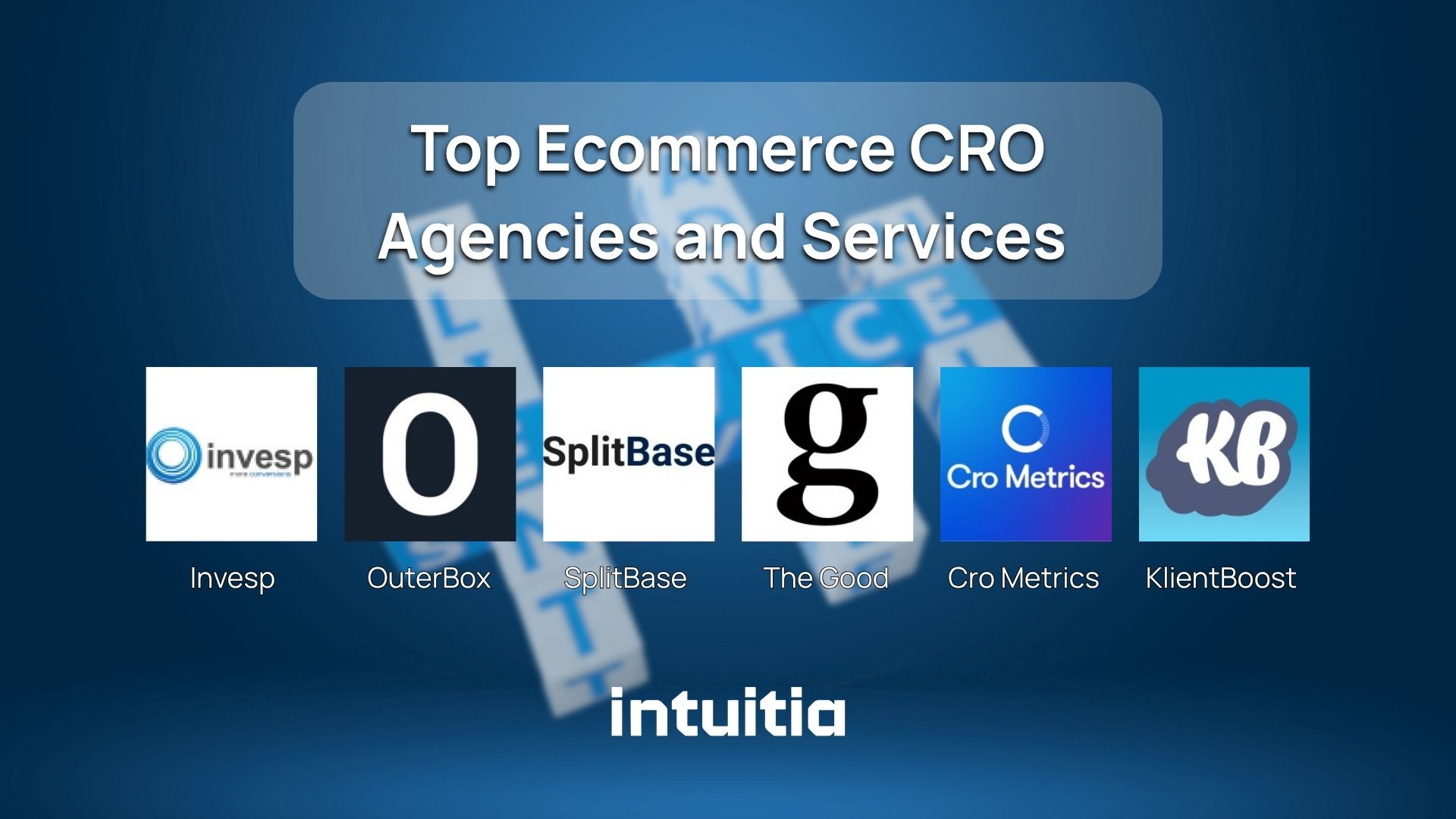
The best ecommerce CRO agencies combine deep testing expertise with ecommerce-specific knowledge. The top names consistently cited in 2025 include Invesp, OuterBox, SplitBase, The Good, Cro Metrics, and KlientBoost.
Each brings a different specialty to the table. Here's a quick breakdown.
You can verify client reviews and ratings for all of these on Clutch's Conversion Optimization Directory, which aggregates verified feedback from real clients.
When reviewing CRO agencies, don't just look at their homepage. Ask to see case studies specific to your industry and platform. An agency with deep Shopify CRO experience is more valuable to a Shopify store than a generalist digital marketing agency.
If you're also evaluating broader design and development partners, reviewing a portfolio of real ecommerce and product work gives you a much clearer picture of what you'd actually be getting.
Professional ecommerce CRO services typically range from $5,000 to $15,000 or more per month for agency retainers, with project-based audits available at lower entry points.
That's a wide range, and for good reason. Pricing depends on the scope of testing, the size of your store, and the level of strategic involvement you need. Here's how the common pricing models break down.
Most top CRO agencies work on a monthly retainer. You get ongoing testing, reporting, and optimization for a fixed monthly fee. This model works best for stores with consistent traffic, typically 50,000 or more monthly visitors, because you need volume to run statistically valid tests.
If you're not ready for a full retainer, a one-time CRO audit is a smart starting point. Audits typically range from $1,500 to $5,000 and deliver a prioritized roadmap of conversion improvements. Many ecommerce businesses start here to validate the opportunity before committing to a longer engagement.
Building an in-house CRO team means hiring a specialist, paying for tools like heatmap software and A/B testing platforms, and building the testing infrastructure from scratch. For most growing ecommerce businesses, an agency is faster to ROI. You get an experienced team, proven processes, and a full toolkit from day one.
The honest answer is that both have a place. Early-stage stores get more value from an agency. Larger operations with significant traffic often benefit from a hybrid model: an agency runs the strategy while an in-house team handles implementation.

Choose an ecommerce CRO service based on your current conversion rate, your specific business goals, the agency's platform expertise, and the strength of their testing methodology.
This decision matters. The wrong CRO partner wastes months and budget on tests that don't move the needle. Here's how to evaluate your options properly.
Before you talk to a single agency, know your numbers. What's your current conversion rate? What's your cart abandonment rate? What's your revenue per visitor? These baselines tell you how much opportunity exists and help you set realistic targets for improvement.
"Improve conversions" is not a goal. "Reduce checkout drop-off from 68% to 50% within 90 days" is a goal. The more specific you are about what you want to improve, the better you can evaluate whether an agency's approach matches your priorities. Some stores need to fix bounce rates. Others need to improve average order value. Some have a checkout problem. Each requires a different CRO strategy.
Ask every agency you consider: how do you build test hypotheses? How do you determine statistical significance? What does your reporting look like? The answers tell you whether they're running real CRO programs or just changing button colors. Look for agencies that do proper UX research and base their recommendations on user behavior data, not intuition.
If you're on Shopify, WooCommerce, or Magento, make sure your CRO partner has hands-on experience with that platform. Each has its own technical constraints that affect how tests are built and deployed. A Shopify CRO agency with proven results on Shopify is worth more than a general agency that hasn't worked in your ecosystem.
The most effective ecommerce CRO best practices focus on removing friction, building trust, and making the path to purchase as clear and easy as possible.
These aren't guesses. They're patterns proven across thousands of tests on real ecommerce stores.
Simplify your checkout. Every extra field is a reason to quit. Remove anything that isn't essential. Enable guest checkout. Show a progress indicator so users know how many steps are left. Add trust signals like security badges and return policy reminders near the "buy" button. Small changes here consistently produce the biggest conversion lifts.
Optimize your product page. Your product page is often the most important page in your entire funnel. Strong product descriptions, multiple high-quality images, clear pricing, social proof in the form of reviews and ratings, and a prominent CTA all work together. A weak product page kills conversions before a visitor even reaches the cart.
Fix your mobile conversion rate. More than half of ecommerce traffic now comes from mobile devices. But mobile conversion rates are consistently lower than desktop. If you haven't done a dedicated mobile CRO review, start there. Navigation, image loading speed, and checkout usability on small screens are the most common culprits.
Use urgency ethically. Low stock warnings, limited-time offers, and real-time social proof like "12 people are viewing this right now" can meaningfully boost conversions. But only when they're true. Fake urgency destroys trust. And trust signals, once lost, are hard to rebuild.
Test your landing page. If you're running paid traffic to a specific landing page, that page should be tested independently from the rest of your store. Landing page optimization is one of the highest-ROI activities in the entire CRO toolkit. Even a 10% improvement in landing page conversion can dramatically reduce your effective cost per acquisition.

The most damaging CRO mistakes are testing too many variables at once, calling winners too early, ignoring mobile users, and copying competitor tactics without validating them for your own audience.
Even experienced ecommerce businesses fall into these traps. Knowing them upfront saves you real money and time.
Testing too many things at once is the classic beginner error. When multiple elements change simultaneously, you can't isolate what actually drove the result. Clean, controlled tests are more valuable than fast, messy ones.
Calling a winner too early is equally costly. If you stop a test after three days because one variation is "winning," you're almost certainly looking at noise, not signal. Wait for statistical significance. Most testing tools will tell you when you've hit it.
Ignoring mobile users is a major missed opportunity. Many CRO programs are designed and reviewed on desktop, even though a large share of actual customers are on phones. Always QA every test variation on mobile before launching.
And finally, copying what competitors are doing rarely works as well as people hope. Your audience is different. Your brand is different. What converts on another store may actively hurt conversions on yours. Use competitor research for inspiration, but always test before you assume it'll work.
Measure the success of your ecommerce CRO campaign using four core metrics: conversion rate, average order value, revenue per visitor, and cart abandonment rate.
These four numbers give you a complete picture of your store's conversion health. Here's what each one tells you.
Conversion rate is the total number of conversions divided by total visitors. This is your primary CRO metric. Even a 0.5% improvement at meaningful traffic volumes translates to significant revenue gains.
Average order value reflects how much each converting customer spends. CRO strategies like upselling and cross-selling aim to move this number up. Higher AOV means more revenue per visitor without needing more traffic.
Revenue per visitor combines conversion rate and AOV into one powerful number. It tells you exactly how much each visitor is worth to your business. This is the metric most serious CRO specialists track above all others.
Cart abandonment rate shows the percentage of shoppers who add items to their cart but don't complete the purchase. The global average hovers around 70%. Bringing this number down even a few percentage points can unlock substantial measurable results.
Set up GA4 with proper ecommerce tracking before starting any CRO program. You need a reliable data foundation. Without it, you're testing blind. Pair that with a heatmap tool and session recording software to understand user behavior at the qualitative level.
If you're working with a custom software development partner to build or improve your store, loop them into your CRO measurement strategy from the start. Technical implementation of tracking is often where data quality breaks down.
Yes. For most ecommerce businesses, it's one of the highest-ROI investments you can make.
Here's the simple math. If your store does $500,000 a month in revenue at a 2% conversion rate, improving that to 2.5% adds $125,000 in monthly revenue without a single extra dollar in ad spend. That's the power of CRO done right.
The key is approaching it correctly. Start with a proper audit to understand where your biggest leaks are. Choose a CRO partner with real ecommerce expertise and a proven testing methodology. Set clear, measurable goals. And give the process time to work.
Whether you're a growing DTC brand or an established ecommerce business looking to maximize revenue from your existing traffic, the right CRO service pays for itself many times over.
Ready to see what your store's conversion rate could look like? Get in touch with the team at Intuitia for a data-driven review of your current setup and a clear path to better results.
What is a good ecommerce conversion rate?
A good ecommerce conversion rate is between 2% and 4%. The average across industries sits at 1.5% to 3.5%. If you're below 2%, a CRO audit is a smart first step.
How long does it take to see results from CRO services?
Most CRO programs deliver initial actionable insights within 6 to 12 weeks. Significant, sustained conversion improvements typically appear within 3 to 6 months of ongoing testing.
How much do ecommerce CRO services cost?
Agency retainers typically range from $5,000 to $15,000 or more per month. One-time CRO audits usually fall between $1,500 and $5,000. Pricing depends on traffic volume, scope, and the agency's level of involvement.
Do I need a lot of traffic for CRO to work?
You need enough traffic to run statistically valid tests. Most CRO agencies recommend a minimum of 10,000 to 20,000 monthly visitors. Below that, tests take longer to reach significance, but a CRO audit can still surface valuable improvements.
What's the difference between CRO and SEO?
SEO drives more traffic to your store. CRO converts more of that traffic into customers. They work best together. SEO fills the funnel. CRO makes sure the funnel actually works.


.svg)










.svg)