
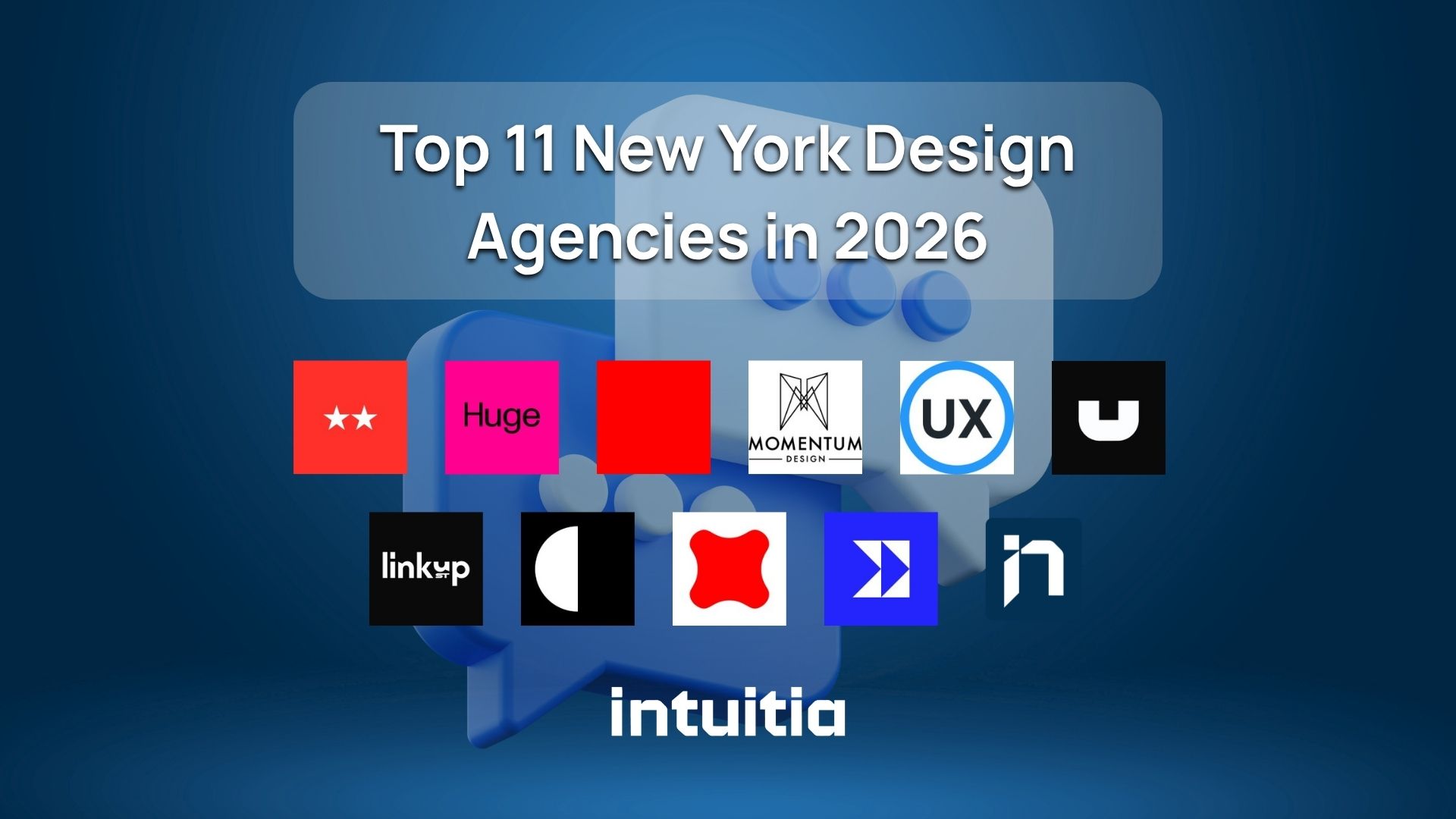
Most "top design agencies" lists are just paid placements dressed up as editorial content. You click through, read a lot of nothing, and leave with zero clarity. This one works differently.
Here is the bottom line upfront: the right design agency for you depends on your stage, your budget, and the actual problem you are solving. Not on who has the biggest name or the most design awards on their wall.
We reviewed 11 agencies in New York City across every tier: enterprise giants billing massive retainers, lean studios that ship in weeks, and specialists so focused they only do one thing. We looked at what each one actually does well, where they fall short, and who they are genuinely built for. So you can stop comparing and start deciding.
New York City's design market is the most competitive in the world. The city runs on speed, pressure, and high standards. Agencies here work with global brands on everything from brand identity and graphic design to web development and digital product development.
But "NYC agency" does not automatically mean quality. Sometimes it just means high overhead passed on to you in a retainer you did not see coming.
Here is what to actually look for before you sign anything:
Specialization vs. breadth: Do they go deep on one thing, or can they handle your full product lifecycle, from brand strategy through web design and digital delivery?
Delivery speed: How fast can they ship something real, not just a concept deck?
Pricing model: Hourly, project-based, or retainer? Each model rewards different behaviors and suits different projects.
Sector experience: Healthcare UX is not the same as fintech UX. Industry knowledge matters more than people admit. Design practices built around compliance-heavy sectors require a completely different approach.
What they actually hand over: Source files, a working design system, and documentation, or just a polished PDF you cannot build from? Design and development should connect, not diverge.
With that framework in mind, here are the 11 design firms worth knowing in 2026.
Before we go deep on each one, here is a side-by-side view so you can quickly spot who fits your situation. Use this as a starting filter, not a final answer.
Best for: Global brands shipping large-scale digital platforms
Based in Brooklyn, Work & Co is one of the few agencies that both designs and builds. Most agencies hand off Figma files to a dev team and call it done. Work & Co ships the actual product. They have delivered for Apple, IKEA, Delta, and Mastercard, and the work holds up at scale.
Their Brooklyn roots give them a no-nonsense culture that is unusual for a creative agency of around 400 people. Strong engineering capability sits right next to design, which means fewer handoff problems and more consistent output across complex, multi-platform systems. Their approach to design and branding is driven by meticulous attention to detail at every stage.
What they do well:
Honest caveat: If you are not a household brand with a serious budget and a 9 to 12 month timeline, they are probably not looking at your brief. This is not a studio for early-stage companies or anyone who needs to move quickly.
Best for: Fortune 500 companies going through digital overhauls
Huge built their reputation on connecting strategy and design into one coherent system. They are one of the original digital design agencies and have grown into a full-service operation with offices in New York and beyond. When getting a strategy wrong could cost your business millions, that depth matters.
What they do well:
Honest caveat: Large team means slower iteration. If you need something shipped in six weeks, Huge is not your answer. Their process is thorough but it moves at enterprise pace, and that pace has a real cost attached to it.
Best for: Brands pushing into connected technology, IoT, and tech-forward campaigns
R/GA sits at an interesting intersection of design and technology. They started as a digital advertising agency, evolved into a product studio, and now bridge physical and digital experiences better than almost anyone. Their offices in New York have been central to global design in the connected tech space. If your product involves hardware, connected devices, or experience design that goes beyond the screen, R/GA has done that work.
What they do well:
Honest caveat: Their background is more campaign and digital marketing than pure product UX. If you need a rigorous usability system for a SaaS platform, they are probably not the best fit for that specific job.
Best for: Enterprise SaaS and data-heavy platforms
Momentum Design Lab does one thing very well: making complicated software feel simple. They specialize in products where users deal with large volumes of data and need to move fast without making mistakes. Think financial dashboards, operations platforms, and logistics management tools where a confusing interface is not just annoying, it costs real money.
What they do well:
Honest caveat: They are a UX strategy and research shop. They will not hand you finished visual design or development. You will need other partners for that, so factor that into your budget and timeline from day one.
Best for: Healthcare, fintech, and other regulated industries
Neuron focuses on workplace tools in high-stakes environments. Their healthcare UX work means they understand compliance rules, clinical workflows, and the real pressure of designing for professionals whose decisions affect lives. That is a very different design process from building a consumer app, and most agencies are not equipped for it.
Understanding UX design principles matters in every industry. But Neuron applies them within high-compliance contexts where getting it wrong has serious consequences beyond just poor reviews.
What they do well:
Honest caveat: Their vertical focus is a feature, not a limitation. But if you are building a consumer lifestyle app or a creative platform, this is not your team. Their design process is calibrated for complexity and compliance, not raw speed.
Best for: Consumer mobile apps where interactions need to feel fast and fluid
Utility is a mobile-first design studio. They specialize in micro-interactions and smooth animations that make an app feel polished without anyone being able to explain exactly why. You know the feeling. You open an app and everything just responds the way you expect it to, every tap feels right. That is the kind of craft Utility focuses on.
For anyone serious about mobile app design, Utility represents the kind of focused creative agency that raises the bar for what good actually looks like on a small screen.
What they do well:
Honest caveat: Mobile UI is their lane and they stay in it. Desktop-heavy tools, branding and website work, or web development are not what you hire them for. If your product lives primarily on web or desktop, look elsewhere on this list.
Best for: Premium brand launches and products where emotional response matters
Linkup ST builds what designers call emotional design. The idea is simple: people do not just use products, they feel things while using them. Linkup ST focuses on making those feelings good. Their work is award-winning and visually distinct, rooted in the belief that great visual storytelling connects a brand to its audience on a level beyond aesthetics.
What they do well:
Honest caveat: Strong on the visual and emotional side. Developer handoff and implementation may require a separate technical partner. Build that cost and coordination time into your plan before you start.
Best for: B2B SaaS brands that want best-in-class visual quality
Clay is a boutique design studio known for some of the best pure visual quality on this list when it comes to B2B SaaS interfaces. Clean, considered, and immediately recognizable as high-end work. They also handle brand identity and website design alongside UI, so you get consistent branding and design from logo to product screen without bouncing between vendors.
If you want to see what great website design looks like at its best for SaaS, Clay's portfolio is worth an hour of your time. Their work raises your internal bar for what you expect your own product to look like.
What they do well:
Honest caveat: They are selective. They do not take every project. And their pricing reflects their positioning as a premium digital design agency. If you are early-stage with a tight budget, Clay is probably not the right starting point for you right now.
Best for: Companies that want to define what their category looks like in the future
Fantasy does conceptual UI and interface design at a level most agencies cannot match. Sports platforms, financial products, media experiences. Their portfolio reads like a preview of things that have not been built yet. When Fantasy does good work, it changes how people think about what an interface can be. They are a genuinely new york city-based studio with a global reputation.
What they do well:
Honest caveat: Visionary outputs do not always translate directly into build-ready specs. Fantasy is exceptional at showing what is possible. You will likely need a strong engineering partner to get it to production.
Best for: Mobile-first consumer startups going from idea to launch
BlueLabel brings product strategy into the design process from day one. They are not just asking what this should look like. They are asking whether it will actually find an audience. That thinking, baked directly into how they approach mobile app development, is genuinely useful for founders who are still validating their idea while building it at the same time.
Their approach to mobile app design is collaborative by nature: strategy, design, and build happen in tight cycles rather than disconnected phases.
What they do well:
Honest caveat: They are primarily a mobile shop. If your product is a web application, a SaaS platform, or anything desktop-first, BlueLabel is probably not the best fit for that specific project.
Best for: Startups, scaleups, and product teams who need professional-grade quality without the enterprise price tag or the enterprise wait time
Here is the honest picture of where Intuitia fits in this list.
Most agencies here do one thing exceptionally well. Intuitia does the whole thing. UX research, UI design, branding, web development, custom software, staff augmentation, and 2D/3D design. And they do it at a speed and cost that the larger agencies above simply cannot match.
That is not a knock on the others. It is just a different model. Intuitia is built for teams who need to move and cannot afford to wait three months before a single screen gets designed.
A real example: healthtech startup Telmora needed a telemedicine platform built from scratch. Intuitia handled the full design and development cycle, and the Telmora case study shows how that process worked end to end.
What they do well:
They have served 300-plus brands globally. From fintech products like MaxProfit to consumer apps. Real products shipped to real users, not concept work sitting in a Figma file. The Intuitia portfolio shows this range clearly across every category they work in.
Their core services include:
Client satisfaction sits at 9.6 out of 10. If you have outgrown freelancers but are not ready to commit to a large agency retainer, Intuitia fills that gap well. For startups looking for a UI/UX designer, it is consistently one of the first names worth checking before you look anywhere else.
Honest caveat: If you specifically need a brand-name agency for investor optics, Intuitia is not positioned that way. Their value is in what they ship, not in the logo on your pitch deck. For some situations, that distinction matters and it is worth knowing upfront.
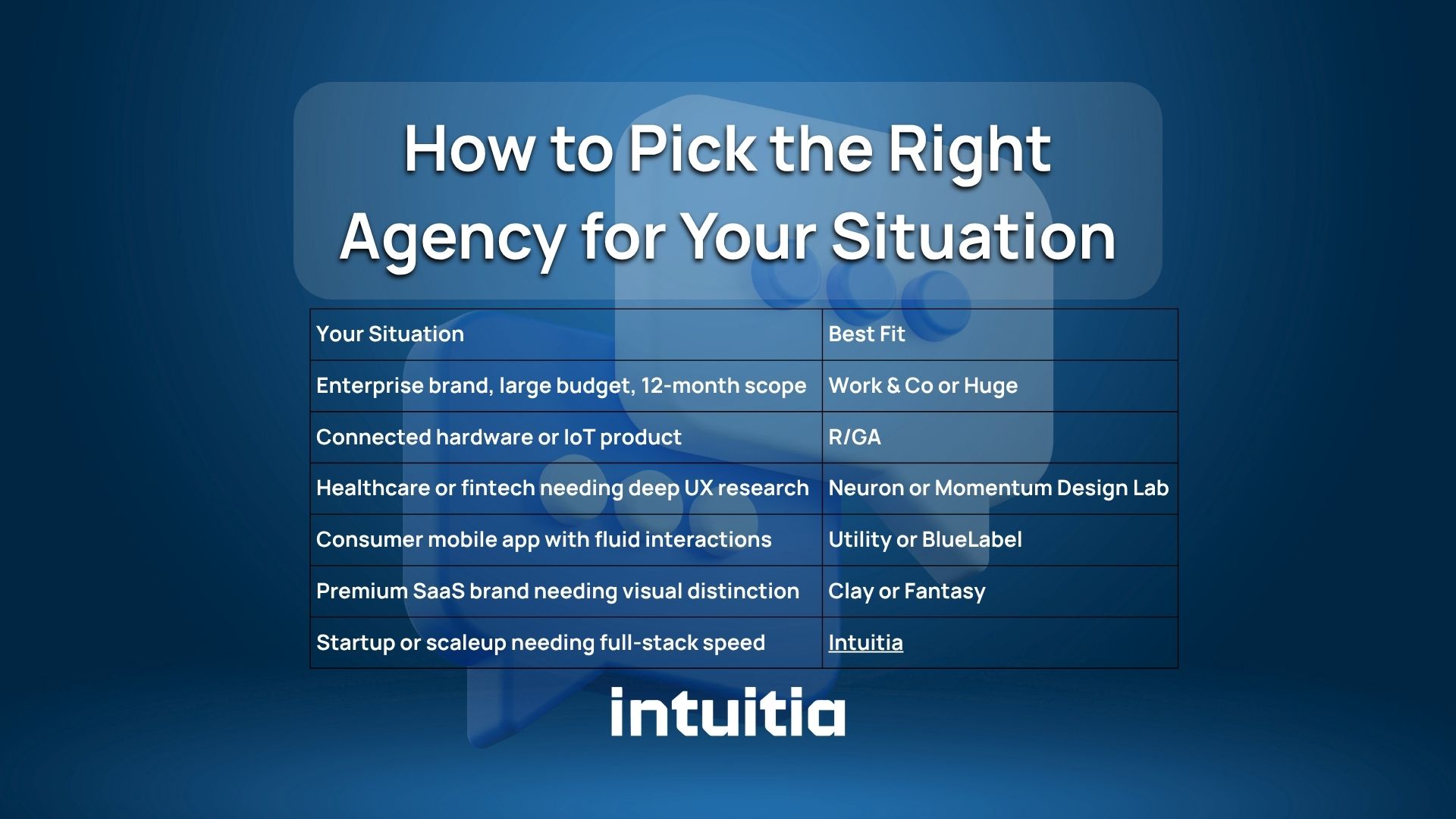
The honest framework is this: match the agency to the stage you are at, not to the one with the most impressive client list on their homepage. Here is a simple way to think about it:
And three questions to ask every agency before you sign anything. These matter more than any portfolio review:
For a deeper look at how to evaluate your options before committing, this guide on the best UX design companies for SaaS products is worth reading. It gives you sharper questions to ask and clearer criteria to compare agencies against.
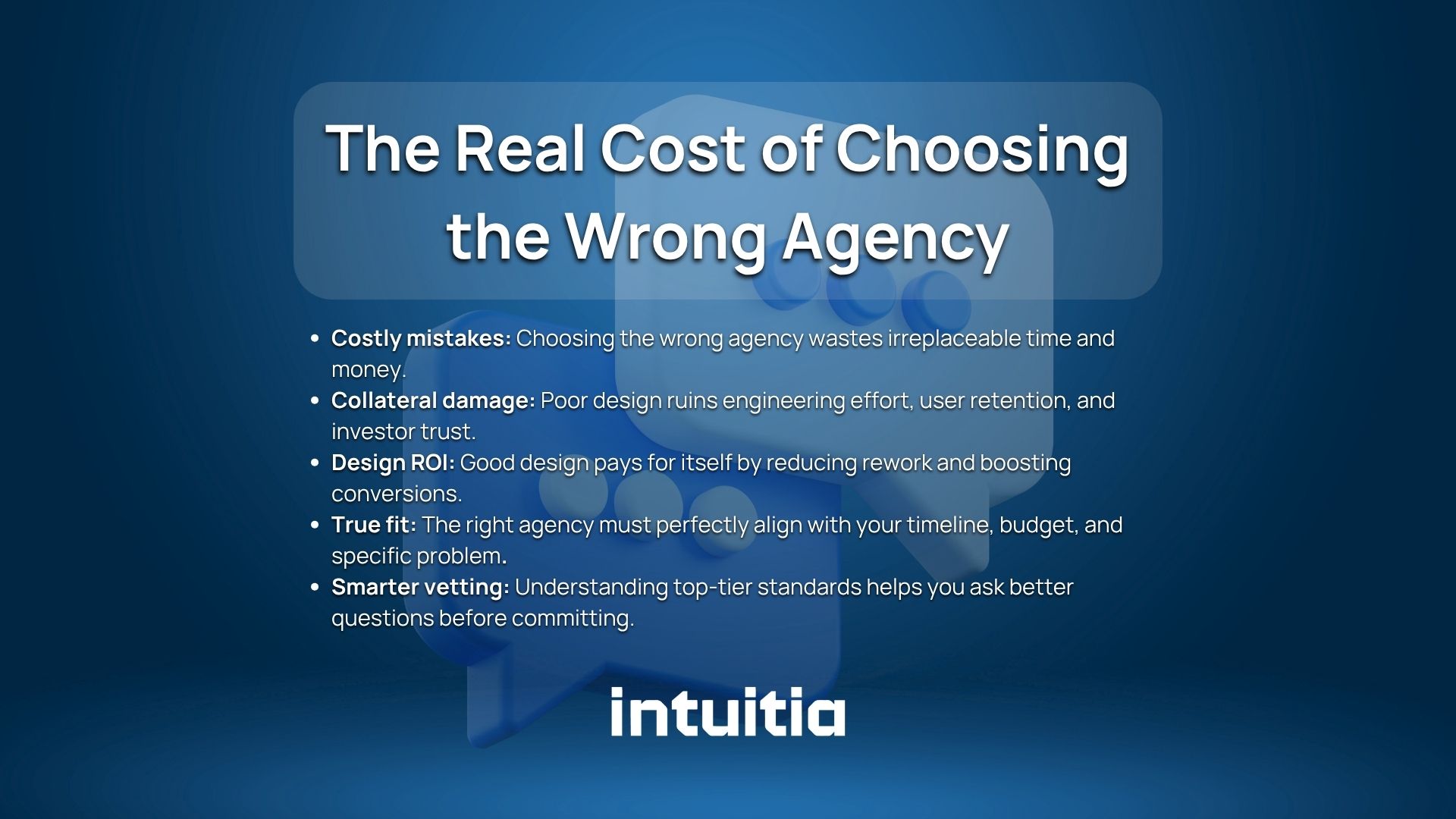
Getting this decision wrong is expensive. Not just in money, but in time. And time is the one thing you cannot get back.
A failed design project does not just cost you the agency fee. It costs you the months you spent waiting. The engineers who built the wrong thing because specs were unclear. The users who left because the product was confusing. And the investor confidence you lost when the demo did not land.
Good product design pays for itself. It reduces development rework, increases conversion, and makes your product easier to support and grow. The right agency is the one that matches your timeline, your budget, and your actual problem. Nothing else on paper matters if those three things do not line up.
For teams navigating this for the first time, understanding what separates top design firms from the rest, in terms of design practices, deliverables, and measurable results, can help you ask sharper questions before you commit. This applies whether you are comparing agencies in New York City or evaluating studios with offices in Los Angeles and beyond.
New York City's design scene is genuinely world-class. But world-class does not mean one-size-fits-all, and it definitely does not mean you need the biggest agency to get the best result for your specific situation.
Work & Co, Huge, and R/GA are excellent if you are a global enterprise with the budget and patience for a long engagement. The specialized studios like Neuron, Momentum, and Utility are outstanding if your problem fits neatly inside their lane. Clay and Fantasy will make your product look exceptional if visual craft is the priority and budget is not the constraint.
And if you need quality, speed, full-stack capability, and a team with real experience in New York City that treats your project like it matters regardless of your company size. Intuitia is the one worth a conversation first.
The best design agency for you is the one that actually ships what you need, on time, at a price that makes sense. Start there and work backwards from that standard.


.svg)







.svg)