
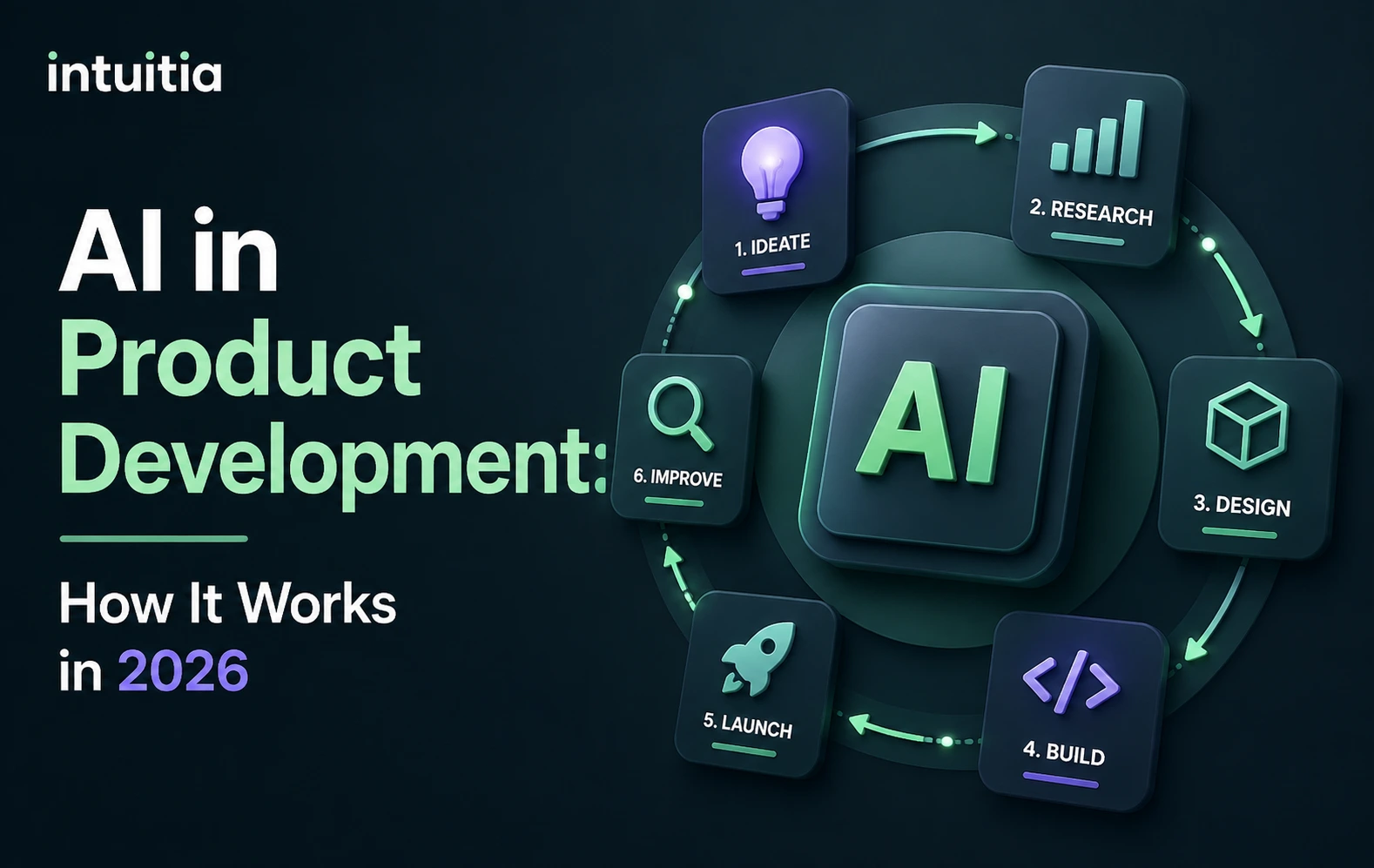
Most new products never make it. Research from Forbes puts the failure rate at 95 percent, and the reasons are almost always the same: weak market fit, missed customer needs, or a launch that took too long to matter. Speed and clarity used to be the hardest things to buy. Now AI in product development is changing that math.
AI now touches nearly every stage of building a product, from spotting a real customer problem to catching a bug before launch day. It doesn't replace the people making the calls.
It gives them better information, faster options, and fewer blind spots. That's the real story here, not hype, just a faster, smarter way to build things people actually want.
The sections below break down what AI in product development actually means, how it works stage by stage, and where it still needs a human hand to guide it. By the end, you'll know exactly where AI earns its place in your process and where design judgment still calls the shots.
AI in product development means using machine learning, generative AI, and predictive analytics to support the stages of building a product, from research through launch. It doesn't design your product for you. It speeds up the grunt work, so your team can focus on decisions that actually need a human brain.
Picture a product team without AI. They read through hundreds of customer reviews by hand, sketch design options one at a time, and wait weeks for QA to catch what a script could catch overnight. Add AI to that same team, and the review analysis takes minutes, the design options multiply, and testing runs while everyone sleeps.
That's the shift. AI product development tools handle pattern recognition, repetition, and data crunching at a scale no team can match manually. Strategy, taste, and judgment still belong to people. Keep that split in mind, because it shapes everything else in this article.
AI matters now because product teams are stuck between rising customer expectations and shrinking timelines, and old methods simply can't keep pace. Customers want more, faster, and cheaper, all at once. Meanwhile, competitors are shipping updates in weeks instead of quarters.
That pressure adds up fast. Teams that research slowly miss trends before a competitor spots them. Teams that prototype slowly burn budget on ideas nobody wanted. And teams that test slowly ship products with problems users find for them, in public, after launch.
AI driven product development directly answers each of these pressure points. It compresses research from weeks to days, turns one design concept into a dozen testable variants, and simulates real-world stress before a single unit gets built.
None of this is about chasing a trend. It's about staying in the game while the game speeds up around you.
With the "why" out of the way, let's look at exactly where AI shows up across the product development lifecycle.
Product teams typically rely on four types of AI, and each one handles a different job across the lifecycle. Knowing what each type actually does makes it much easier to pick the right tool for the right problem, instead of throwing AI at everything and hoping it sticks.
Most teams don't use just one type. A typical workflow might lean on NLP during research, generative AI during design, and predictive analytics during testing, all feeding into the same product decision.
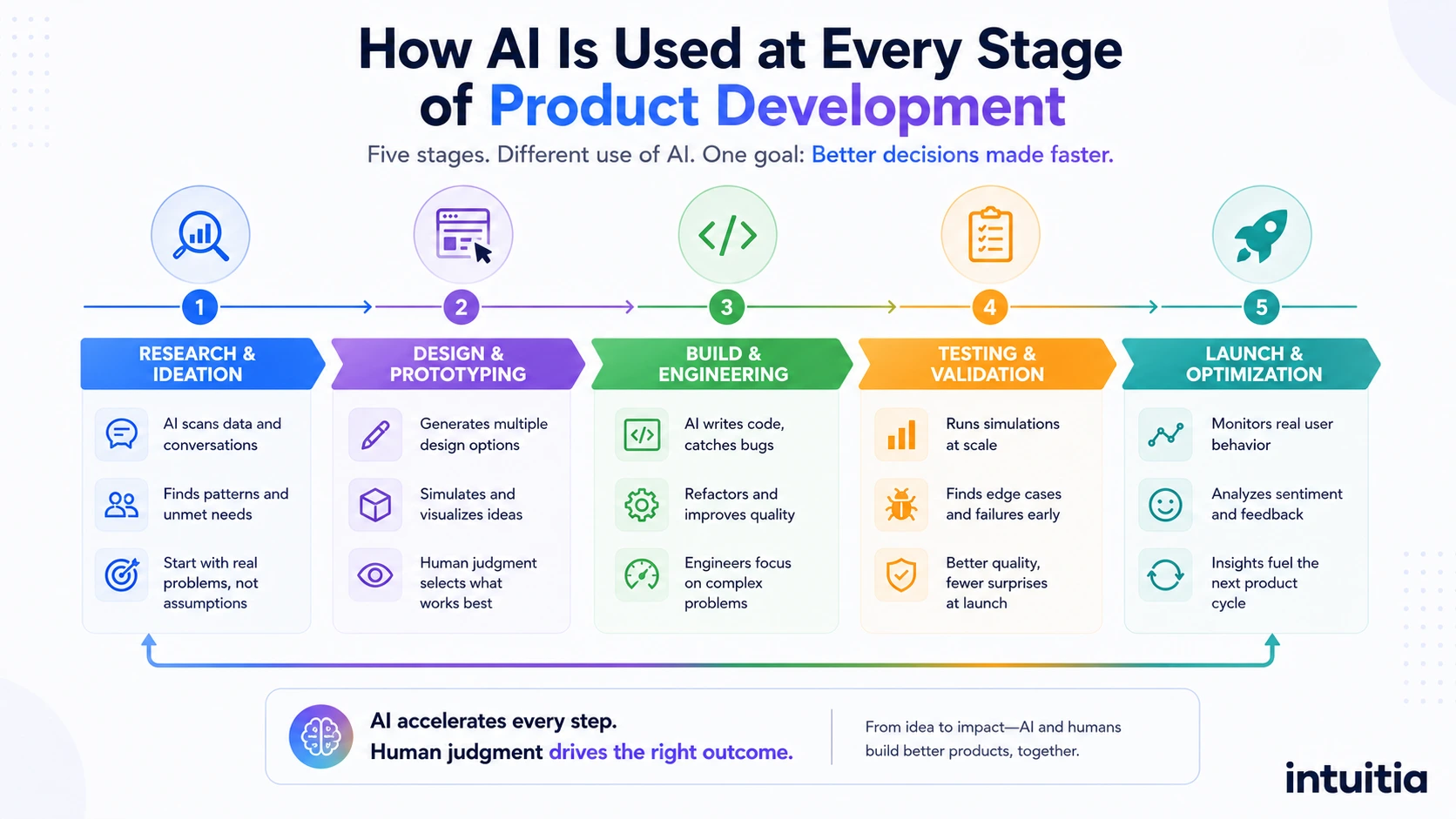
AI supports five key stages of product development: research and ideation, design and prototyping, build and engineering, testing and validation, and launch and optimization. Each stage uses AI a little differently, but the goal stays the same across all five, better decisions made faster.
AI speeds up research by scanning massive amounts of customer data to surface patterns no human could spot by reading one review at a time.
Natural language processing tools sift through app store reviews, support tickets, and social media mentions to flag recurring complaints and unmet needs. What once took a research team weeks now takes days.
This matters because the biggest product failures rarely come from bad execution. They come from solving a problem nobody actually had. AI won't tell you what to build, but it will tell you, with real data, what people are frustrated about right now. That's a much stronger starting point than a hunch in a meeting room.
Getting this stage right often comes down to knowing the difference between what the market says it wants and what individual users actually need day to day, a distinction worth understanding on its own, market research and user research aren't the same thing, and mixing them up early tends to cost teams later.
AI shortens the design phase by generating multiple layout, wireframe, and prototype variants from a single brief, so teams can compare options instead of building one at a time. Generative design tools can produce dozens of directions in the time it used to take to sketch three. AI-enhanced CAD and 3D tools can even simulate how a physical product performs before a prototype exists.
Here's the catch, though. More options are only useful if someone with real design judgment knows which ones actually solve the problem and feel right to use. AI can generate variety.
It can't tell you which version builds trust with a first-time user or reduces friction in a checkout flow. That still takes a trained eye and real UX thinking, which is exactly where a dedicated UX design process earns its keep, turning raw AI output into something people genuinely want to use.
Once a direction feels right, the next question is whether it can actually be built, and built well.
AI accelerates the build phase through coding assistants that write boilerplate, catch bugs early, and refactor messy code, freeing engineers to focus on harder problems.
AI agents can now handle a meaningful share of repetitive development tasks that used to eat hours of a developer's day. Predictive tools also flag likely failure points before they turn into expensive rework.
That said, speed without structure creates its own mess. Teams that lean on AI-generated code without solid architecture and code review often end up with something that works today and breaks under real load tomorrow. The fastest, cleanest builds still come from teams that pair AI tools with genuine custom software development expertise, not one instead of the other.
Building fast only pays off if what you build actually holds up, which brings us to testing.
AI strengthens testing by running virtual simulations and automated checks that catch performance, safety, and edge-case issues long before real users ever touch the product.
Instead of testing one scenario at a time, machine learning models can run thousands of variations overnight, comparing how a design performs under different conditions, loads, and user behaviors.
This is where a lot of quiet product failures used to slip through. A feature that worked fine for the QA team but broke the moment ten thousand real users hit it at once. AI-driven testing catches far more of these gaps before launch day, which means fewer emergency patches and far less damage to a brand's reputation right out of the gate.
Once a product clears testing, the real feedback begins, and that's where AI keeps working long after launch.
AI improves the launch phase by tracking real user behavior, predicting adoption trends, and flagging problems the moment they show up in the data, not weeks later in a support ticket. Sentiment analysis tools read reviews and social mentions in real time. Anomaly detection spots unusual drop-off or error spikes almost as soon as they happen.
That closes the loop back to where the whole process started. Insights from launch feed directly into the next research cycle, so every product a team ships makes the next one smarter, faster, and better matched to what customers actually want.
That full lifecycle view sets up the next question naturally: what does all this speed and insight actually get you?
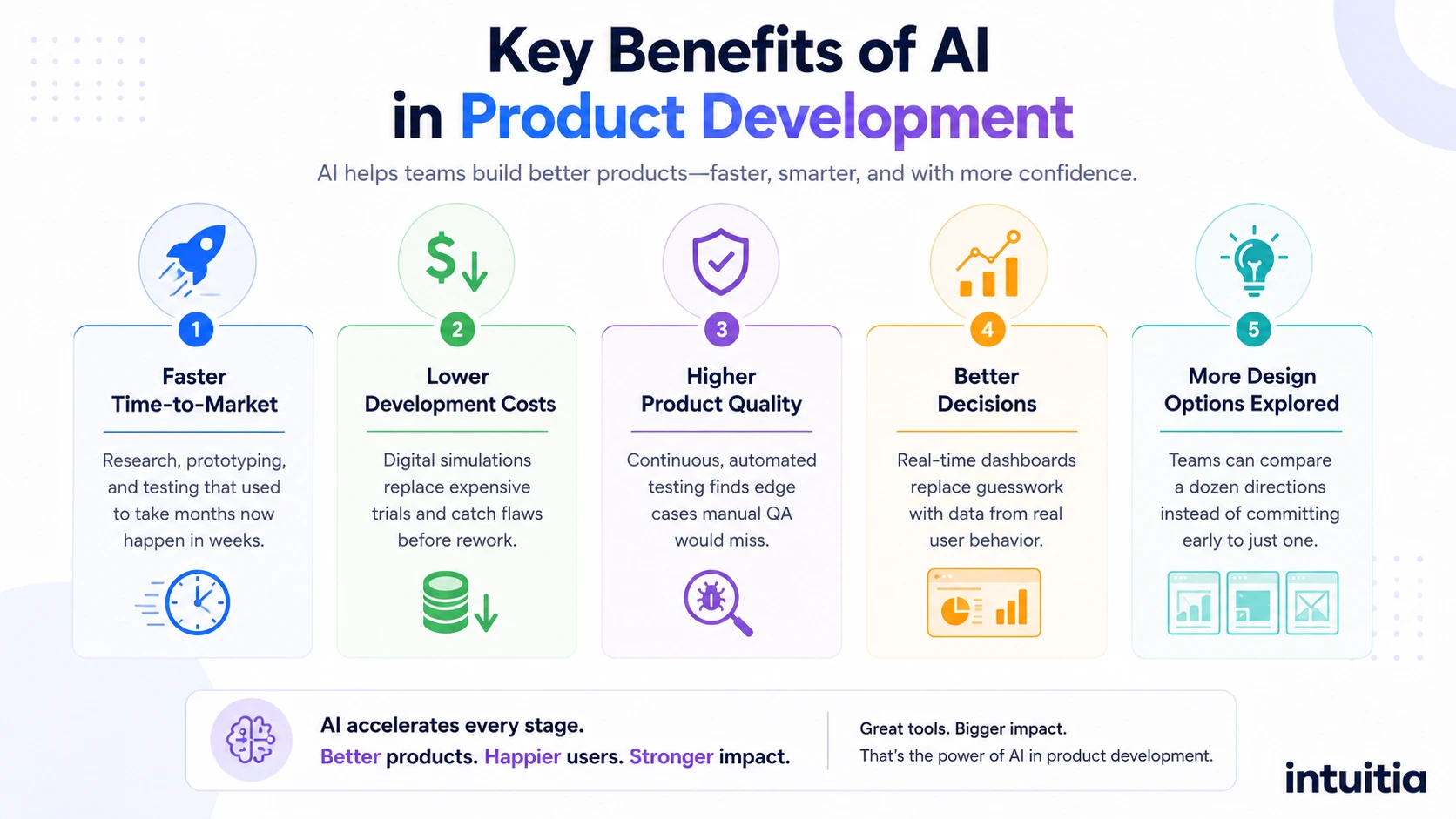
The core benefit of AI in product development is speed without sacrificing quality, since teams can test more ideas, catch more problems, and launch faster than manual processes ever allowed. Here's what that looks like in practice:
Every one of these benefits sounds great on paper. But AI adoption isn't automatic, and it isn't risk-free either.
The biggest challenge with AI in product development is that it amplifies whatever you feed it, so bad data, unclear goals, or too much automation can do real damage fast. Speed cuts both ways. A flawed process moving twice as fast just produces flawed results twice as fast.
A few patterns show up again and again with teams that struggle:
None of this means AI isn't worth using. It means AI works best inside a process that still has clear human ownership at every key decision point.
A useful gut check: if an AI tool made the wrong call in your workflow tomorrow, would anyone on your team notice before a customer did? If the honest answer is no, that's usually a sign the automation has outrun the oversight around it. So how does a team actually start, without falling into that trap?
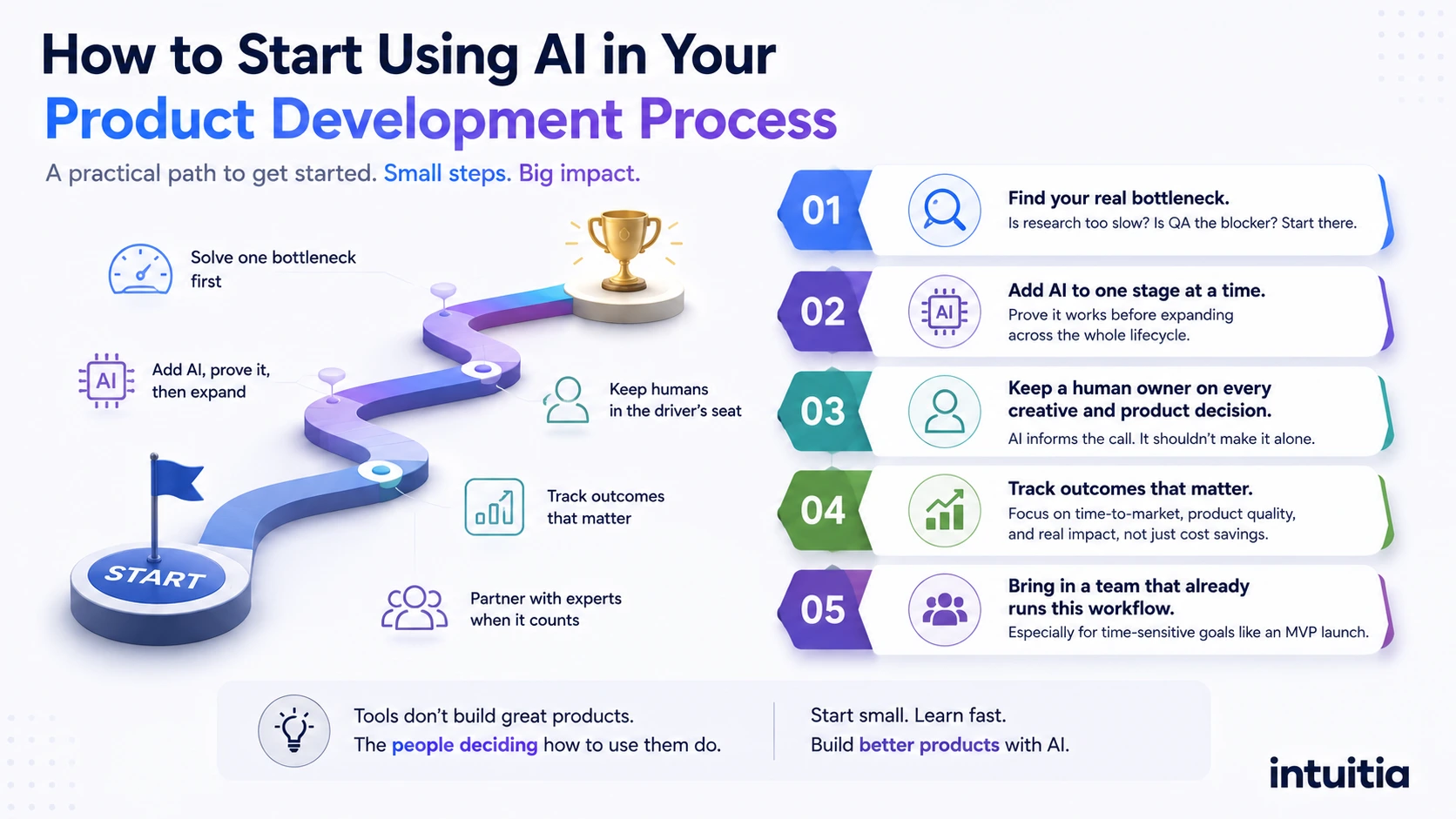
The best way to start using AI in product development is to fix one clear bottleneck first, rather than trying to overhaul your entire workflow at once. Small, focused wins build the confidence and the workflow habits that make bigger AI adoption actually stick.
A practical path looks like this:
That last point matters more than it might seem. Tools alone don't build good products. The people deciding how to use them do.
AI can generate design variants, write code, and crunch data faster than any team ever could, but deciding what actually belongs in a product still takes real human judgment. That's the honest line, and it's worth saying plainly instead of dancing around it.
A generative tool can hand you twenty logo directions in a minute. It can't tell you which one will make a stranger trust your brand in the three seconds before they scroll past it. That kind of read on human behavior comes from people who've watched real users struggle with real products, not from a model trained on averages.
This is exactly where the strongest product teams operate today, using AI to move fast while keeping design and product strategy firmly in human hands. You can see that balance play out across real, shipped products in Intuitia's portfolio, where AI-assisted speed meets design work built around how people actually behave, not just how fast something can be produced.
Speed matters. But speed aimed in the wrong direction just gets you to the wrong place faster.
What is AI in product development?
AI in product development is the use of machine learning, generative AI, and predictive analytics to support research, design, engineering, testing, and launch. It speeds up repetitive and data-heavy work so teams can focus on strategy and design decisions.
What are the stages of AI in product development?
The five main stages are research and ideation, design and prototyping, build and engineering, testing and validation, and launch and optimization. AI plays a different but connected role at each one, from spotting customer needs early to catching problems after launch.
Can AI replace product designers?
No. AI can generate design variants and speed up prototyping, but it can't judge what actually works for real users or builds trust with a brand. Design judgment, user empathy, and strategic decisions still require human expertise.
What tools are used for AI product development?
Common categories include generative design and prototyping tools, AI coding assistants, predictive analytics platforms, and NLP-based sentiment analysis tools. Most teams combine a few of these rather than relying on just one.
Is AI product development expensive to start?
Not necessarily. Many teams start small by applying AI to a single bottleneck, like research or testing, before expanding further. Costs scale with how many stages and tools you adopt, not with the decision to start using AI at all.
AI in product development isn't a shortcut, and it isn't optional anymore either. It's simply how modern teams research faster, design smarter, and catch problems before customers do.
The teams pulling ahead right now are the ones pairing that speed with real design and product judgment, not the ones treating AI as a replacement for either.
If you're building a product and want AI-enhanced speed without losing the design quality that makes people actually stick around, that's exactly the balance we work in every day. Get in touch with Intuitia and let's talk about where your process could move faster without cutting corners on what matters.



.svg)






.svg)