Not long ago, building an MVP meant months of planning, a technical co-founder you didn't have yet, and a launch date that kept sliding right. Today, that same product can go from a rough idea to a working prototype in a matter of days.
AI MVP development uses AI tools, automated workflows, and lean product principles to build and test a software idea fast, often in days or weeks instead of months. It's not about replacing good judgment with automation. It's about removing the friction that used to slow founders down before they knew if their idea was worth building.
This guide covers what AI MVP development actually looks like: the process, the tools, the real costs, and the mistakes that quietly sink most AI-first products.
AI MVP development is the process of using AI tools and lean methods to build a minimum viable product that tests both market demand and whether an AI feature genuinely improves the user's workflow. You're not just asking "does this app work?" You're asking "does the AI inside it actually make someone's life easier?"
That second question separates AI MVP development from a regular software MVP. A traditional MVP tests a feature set. An AI MVP tests a feature set and a probabilistic system at the same time, one that behaves a little differently every time a user interacts with it.
Picture an app that helps freelancers write client proposals faster. The MVP isn't just "does the app work." It's "does the AI-written first draft actually save the freelancer time, or does it create more editing work than it saves?" That's the real test.
Once you get that distinction, the rest of the process makes sense. So let's look at how an AI MVP actually differs from the MVP you might already know.
The biggest difference between an AI MVP and a traditional MVP comes down to speed, validation method, and risk. A traditional MVP validates a static feature set. An AI MVP validates a feature set that changes its output based on data, prompts, and context, so it needs a different kind of testing.
Here's how the two compare side by side:
Every extra layer in an AI MVP exists because AI output isn't fixed. It shifts depending on the data you feed it and the prompts you write, which is exactly why testing needs to go one step further than a normal MVP.
That extra layer matters more than founders expect. According to Stack Overflow's 2025 Developer Survey, 84% of developers now use or plan to use AI tools, yet only 29% say they trust the accuracy of what those tools produce. If professional developers stay cautious about AI output, your users will too.
Speed and lower upfront cost make AI MVP development attractive. But speed only helps if you're building the right thing, which brings us to the question most founders skip.
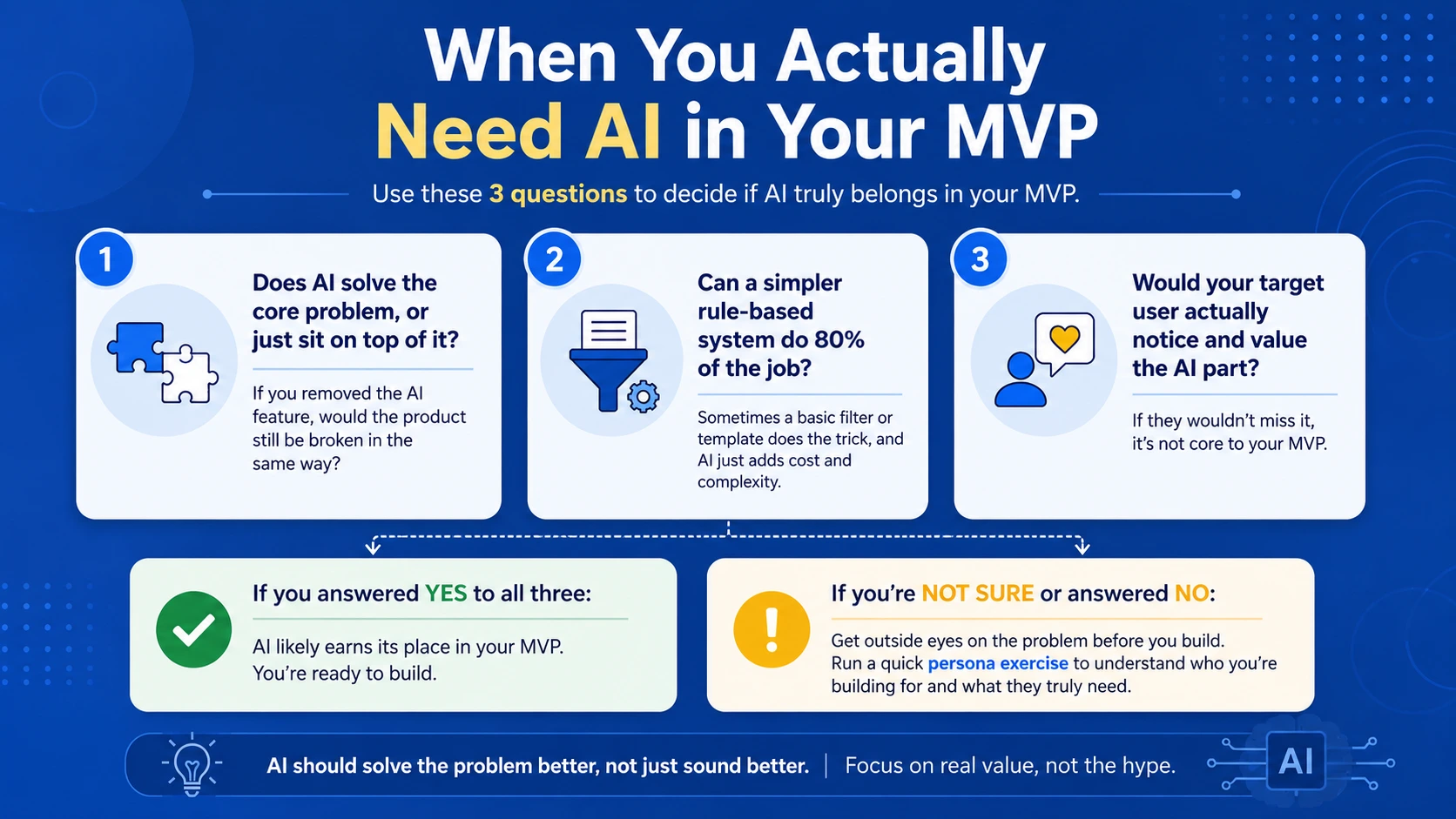
You need AI in your MVP only when it solves the core problem better than a simpler solution could, not because AI sounds impressive on a pitch deck. This is the single most common mistake in AI MVP development, and it's easy to avoid if you ask the right questions early.
Founders fall in love with the idea of an AI-powered product before they've confirmed the problem is real. It's a natural trap. AI is exciting, investors like hearing about it, and building "just a form" feels less thrilling than "an intelligent assistant." But excitement doesn't equal usefulness.
Run your idea through these three questions before you write a single line of code:
If you answer these honestly and AI still comes out as essential, you're in good shape. If you're not sure, that's usually a sign you need outside eyes on the problem before you build anything. A quick persona exercise can also help you pin down exactly who you're building for and what they actually need, before AI enters the picture at all.
Once you've confirmed AI genuinely earns its place in your product, you're ready for the real work: building it. Here's the process that keeps that build focused and fast.
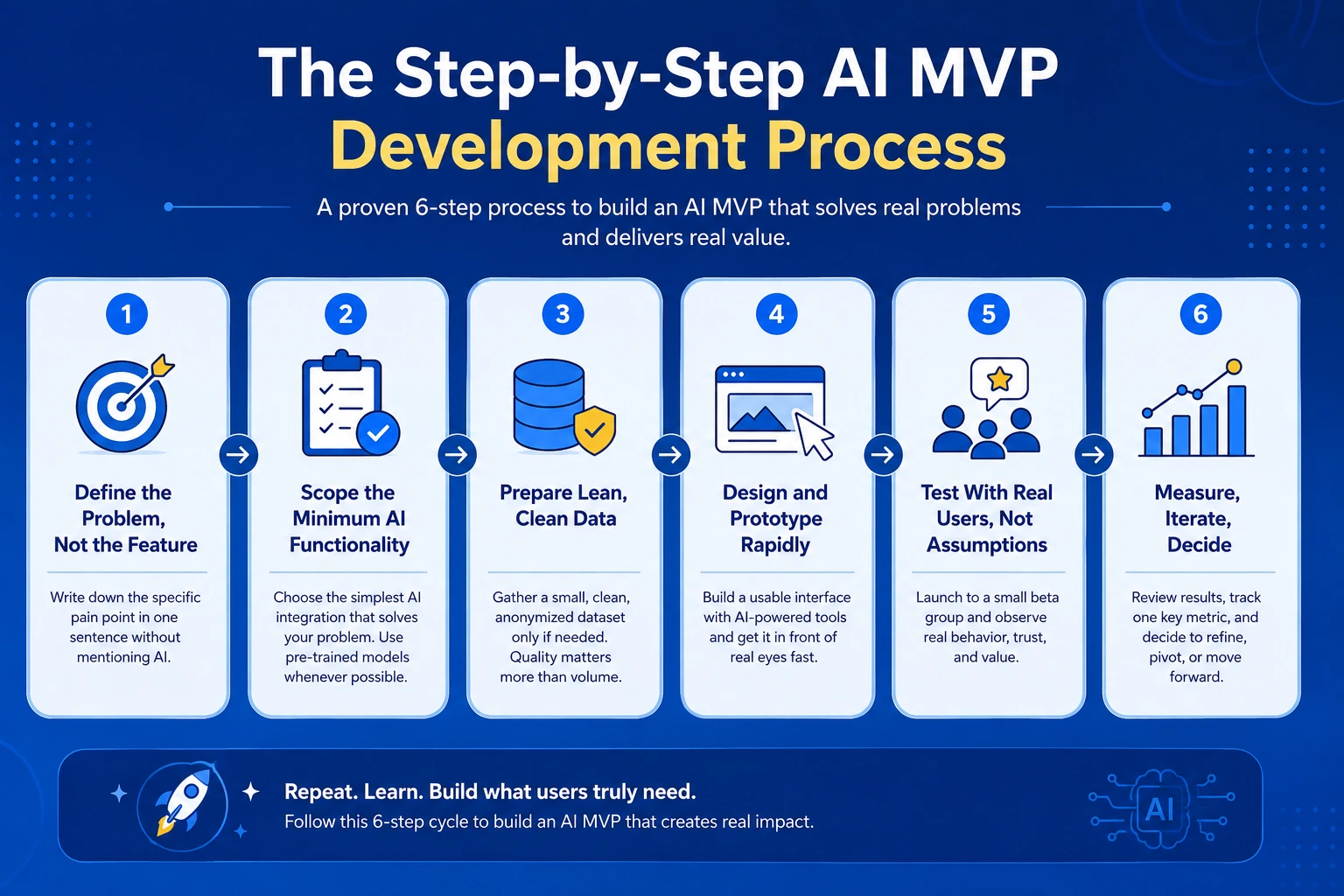
The AI MVP development process follows six steps: define the problem, scope the minimum AI functionality, prepare lean data, prototype rapidly, test with real users, and iterate based on what you learn. Skip any one of these, and you risk building something polished that nobody actually needs.
Let's go through each step.
Start by writing down the specific pain point you're solving in one sentence, without mentioning AI at all. If you can't do that, you're not ready to build yet.
A good problem statement sounds like "freelancers spend two hours writing each client proposal and lose momentum on other work." A weak one sounds like "we're building an AI proposal generator." One describes a real frustration. The other describes a feature.
Pick the simplest AI integration that solves your problem, whether that's an API call to an existing large language model, a basic recommendation engine, or a lightweight automation rule. Training a custom model from scratch is rarely the right move for an MVP.
Most AI MVPs today plug into pre-trained foundational models rather than building anything from the ground up. That choice alone can cut your development time from months to weeks.
Gather a small, clean, anonymized dataset only if fine-tuning is genuinely necessary, and rely on pre-trained models wherever you can. Bad data creates bad AI output faster than almost anything else in the process, so quality matters more than volume here.
If you're handling user information, keep collection minimal and purposeful. You need just enough to prove the concept works, not a warehouse full of records you don't yet know how to use.
Turn your idea into a usable interface using natural language prompts in AI-powered design tools, then get it in front of real eyes fast. This is where a lot of AI MVPs either come together or fall apart, because a confusing interface can bury even a genuinely useful AI feature.
Good design isn't a nice-to-have here. It's the difference between a user understanding your AI feature in five seconds and giving up before they try it. Teams that pair fast AI prototyping with proper UI design tend to get cleaner signal from testing, simply because users aren't confused by the interface itself.
Launch to a small beta group and watch how they actually use the product, not how you assumed they would. Real usage data beats your best guess every time.
Pay attention to where users hesitate, where they abandon a task, and whether they trust the AI's output enough to act on it. That last point matters more than most founders realize. An AI feature can be technically accurate and still fail if users don't trust it enough to use it. Solid user research here saves you from chasing the wrong fixes later.
Review your results against the one metric that matters most, then decide whether to refine, pivot, or move forward with confidence. This step tells you whether you found real product-market fit or just built something that looks nice in a demo.
That six-step cycle is the backbone of every successful AI MVP. Naturally, the tools you use at each step matter too, so let's look at what's actually working right now.
The right AI MVP tools fall into three categories: UI and app generators, AI coding assistants, and backend or workflow automation platforms. You don't need all three on day one, but knowing what each does well helps you pick the right one for your stage.
Here's the honest truth though. Tools accelerate output, but they don't replace product judgment. A fast tool in the wrong hands still builds the wrong thing, just faster. That's exactly how most AI MVPs run into trouble, and it's worth understanding why before you start building.
Most AI MVPs fail for the same handful of reasons: they skip real problem validation, generate unmaintainable code, avoid genuine user testing, or have no plan beyond the prototype stage. None of these failures come from AI being unreliable. They come from how people use it.
According to CB Insights, 43% of startups fail due to poor product-market fit, not a lack of funding or talent. That number holds steady whether AI is involved or not. AI speeds up building, but it doesn't fix a weak starting idea.
Here are the failure patterns worth watching for, and how to sidestep each one:
Avoiding these mistakes isn't complicated, but it does take discipline, and often a second set of eyes that isn't emotionally attached to the idea. That's usually where the DIY vs agency question comes in, so let's tackle it directly.
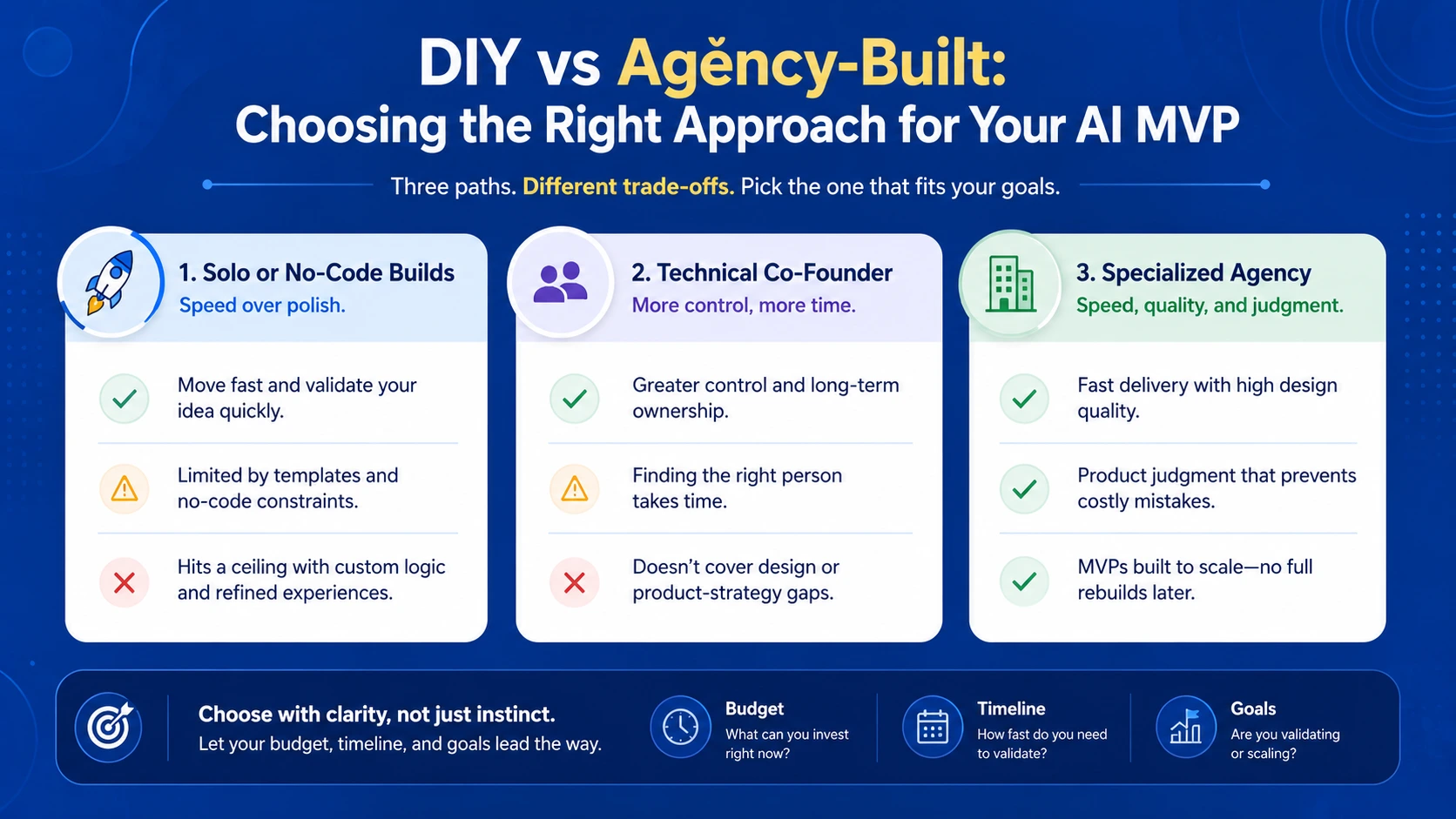
The right approach for your AI MVP depends on your budget, timeline, and how much you're willing to trade design quality and scalability for speed. There's no single correct answer. Each path makes sense in different situations.
That third option is where a lot of founders eventually land, especially once they've felt the pain of a prototype that looked fine in a demo but couldn't hold up once real users touched it. Design-led teams that pair fast AI-assisted building with genuine UI and UX thinking, the kind you'll find through Intuitia's custom software development service, tend to produce MVPs that don't need a full rebuild six months later. Prefer to scale your existing team instead of handing off the whole build? Team augmentation is worth a look too.
Whichever path you choose, cost and timeline should guide your decision as much as your gut feeling. Let's break those down honestly.
AI MVP development costs typically range from a few thousand dollars for a simple no-code build to $30,000 to $80,000 or more for a fully custom, design-led product, and it takes anywhere from a few days to two or three months depending on scope. These numbers vary widely, so treat them as a starting compass, not a fixed quote.
Here's what shapes the number:
Traditional MVPs take three to six months because they're built from scratch, feature by feature. AI-assisted MVP stacks compress that same work into days or weeks, largely because pre-trained models and AI-assisted coding remove so much manual groundwork.
One honest caveat. Cheaper and faster only pays off if the result holds up under real users. A rushed MVP that needs a full rebuild in three months didn't really save you time or money at all.
With the numbers out of the way, let's answer a few quick questions that tend to come up at this stage.
What is an AI MVP?
An AI MVP is an early, working version of a product that uses AI to solve a specific user problem while testing whether that AI feature is actually worth building further. It's built to validate demand and usefulness quickly, using minimal time and resources.
How is AI MVP development different from a regular MVP?
AI MVP development tests both the product's core features and the quality of its AI output, while a regular MVP only tests the features. That extra layer of validation exists because AI output changes based on data and prompts, so it needs ongoing checks that static features don't.
What is the fastest way to build an AI MVP?
The fastest way is pairing an AI-powered UI generator with a pre-trained large language model through a simple API connection, skipping any custom model training. This approach can take your idea from concept to working prototype in days rather than months.
Do I need a data scientist to build an AI MVP?
Most AI MVPs don't require a data scientist, since they rely on pre-trained foundational models instead of custom-built ones. You'll only need specialized data science expertise if your MVP genuinely requires fine-tuning on your own proprietary dataset.
How much does it cost to build an AI MVP?
Costs range from a few thousand dollars for a simple no-code build to $30,000 to $80,000 or more for a fully custom, design-led product. The right number depends heavily on how much custom logic, design polish, and scalability your MVP actually needs.
Building an AI MVP isn't about chasing the newest tool. It's about proving your idea works before you spend real money finding out the hard way. Here's what to remember:
If you're ready to move past the idea stage and want a team that pairs fast AI-assisted building with real design and product thinking, take a look at Intuitia's portfolio to see how that approach plays out in practice, or get in touch to talk through your idea. Either way, the sooner you validate, the sooner you'll know if you've got something worth scaling.



.svg)






.svg)