
Most B2B companies still take orders over the phone. Or by email. Or through a sales rep who manually enters everything into a spreadsheet.
And then they wonder why their competitors are growing faster.
Here is the reality: 64% of B2B buyers now prefer digital channels over traditional ones. One in three completes their entire sales journey online. Your buyers are not waiting for a call back. They are searching, comparing, and placing orders right now. If your website cannot handle that, you are handing business to someone who can.
This guide covers everything you need to know about B2B ecommerce website development. What it involves, what features you need, how to build one step by step, and what to watch out for along the way.
B2B ecommerce website development is the process of building a digital platform that lets one business sell products or services to other businesses online. It is not just putting a product catalogue online. It involves custom pricing structures, complex purchasing workflows, system integrations, account management tools, and a buyer experience built for professional purchasing teams.
The market behind it is enormous. The global B2B ecommerce market was valued at $19.34 trillion in 2024 and is projected to reach $47.54 trillion by 2030, growing at a CAGR of 16.17% (Research and Markets). In the US alone, B2B ecommerce site sales reached $2.3 trillion in 2024, growing more than 10% year over year.
Gartner predicts that 80% of B2B interactions will take place digitally by 2025. B2B leaders already expect more than half of their revenue to come from digital channels. That shift has turned B2B ecommerce from a nice-to-have into a core part of how businesses operate and grow.
Having your own B2B ecommerce website also gives you something third-party platforms cannot: direct control over your customer relationships. When you own the channel, you own the data, the experience, and the loyalty. That is a meaningful long-term advantage.
B2B and B2C ecommerce share the same basic concept: selling online. But the underlying buying behavior, pricing structures, and relationship models are completely different.
B2B buyers today are shaped by their personal B2C shopping habits. They expect the same speed and convenience they get from Amazon. But behind the scenes, their purchasing process is far more complex. Copying B2C design patterns for a B2B ecommerce site almost always leads to a poor experience for business buyers.
A successful B2B ecommerce website needs more than a shopping cart. The features that drive results in B2B are built around account management, pricing flexibility, and operational efficiency. Here is what you need.
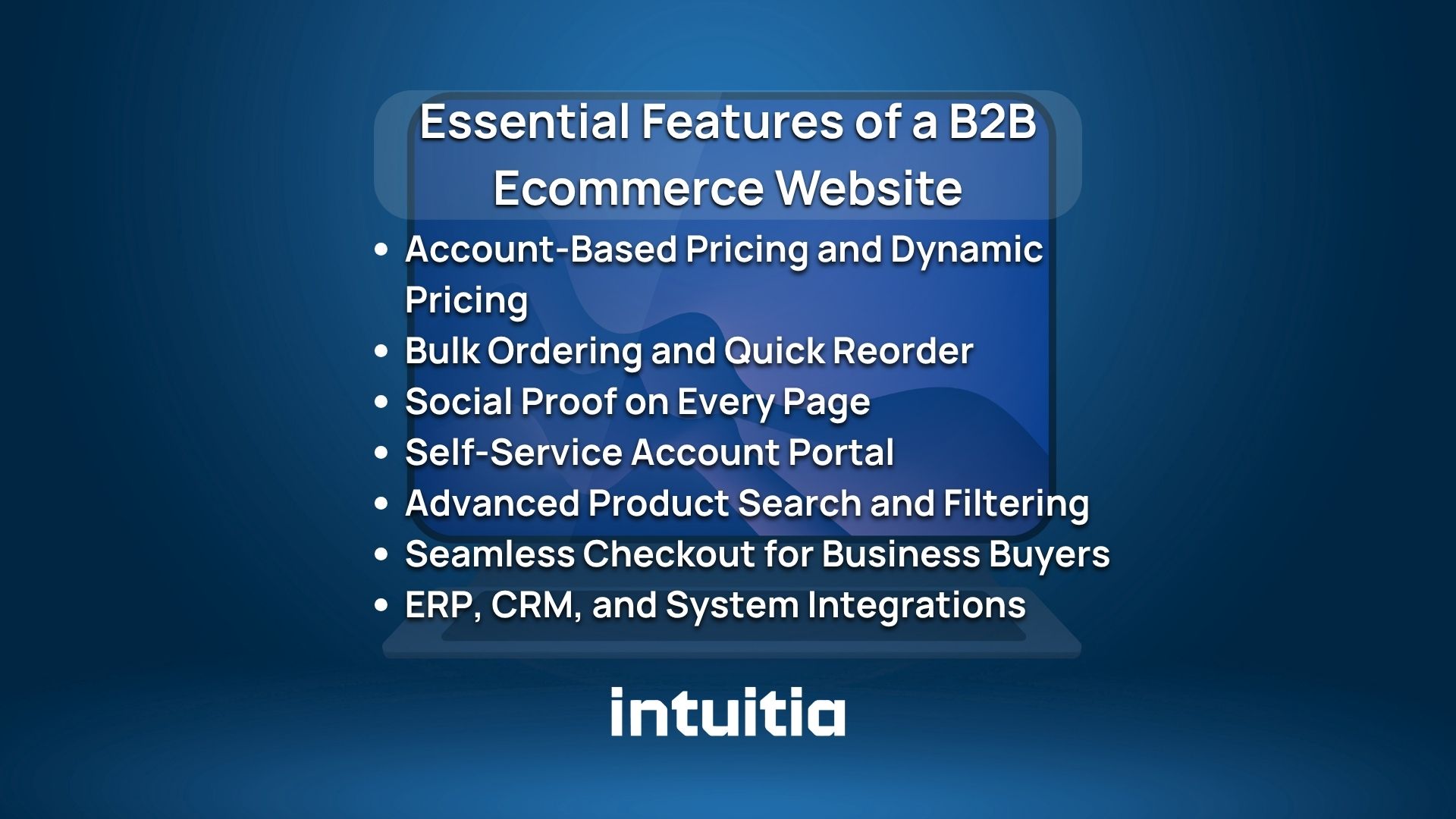
In B2B, different customers pay different prices. A long-term distributor gets a different rate than a new wholesale buyer. Your ecommerce platform needs to support account-specific price lists, bulk order discounts, and promotional pricing for regular reorders.
Dynamic pricing is not just a nice feature. It is a core B2B requirement. Without it, your sales team ends up handling pricing manually, which defeats the purpose of having an ecommerce site at all.
B2B buyers order in volume. And they order again and again. Your site needs to make both of those things easy.
Bulk ordering tools include quantity selectors, minimum order quantities, and the ability to add multiple product variants to a cart at once. Quick reorder lets buyers repeat a previous order in a few clicks, without starting from scratch. For many B2B customers, this single feature determines whether they use the site or pick up the phone instead.
Business buyers want to manage their own accounts without calling your support team. A proper B2B account portal lets buyers:
This self-service capability reduces your operational costs and significantly improves customer satisfaction. It also supports customer retention by making repeat purchasing genuinely easy. When a buyer can log in, see their order history, and reorder in three clicks, they have very little reason to look elsewhere.
B2B product catalogues are often large and technically complex. A buyer searching for a specific industrial component or software configuration needs to find it fast. Faceted search with multiple filters, category-based navigation, and a smart site search function are not optional extras. They are fundamental to a usable B2B ecommerce experience.
Poor product search is one of the leading causes of cart abandonment in B2B ecommerce. If buyers cannot find what they need quickly, they leave.
The checkout experience in B2B ecommerce needs to support things that a standard consumer checkout does not. Purchase order numbers, invoice-based payment, split billing, multi-location shipping, and custom approval workflows are all common B2B requirements.
Reducing friction at checkout directly impacts your conversion rate. Every extra step or field that is not relevant to your buyer increases the chance they abandon the process. Build checkout around how your buyers actually purchase, not around what is easiest to configure.
This is where B2B ecommerce website development gets genuinely complex. A B2B site that operates in isolation from your other business systems creates data silos and manual work. The most critical integrations are:
Without proper system integration, your ecommerce site and your back-office operations will constantly conflict. Inventory will be inaccurate. Pricing will be wrong. Orders will need manual correction. Getting integration right from the start saves enormous time and cost later.
Building a B2B ecommerce website is a multi-stage process. Each step depends on the one before it. Rushing through early decisions creates expensive problems later.
Before you choose a platform or write a line of code, define what success looks like. Set measurable goals. How much online revenue do you want to generate in year one? What percentage of orders do you want to shift from manual to digital? Which customer segments are you targeting first?
Clear goals determine every decision that follows. They shape which platform you choose, which features you prioritize, and how you measure whether the project worked.
This is one of the most consequential decisions in B2B ecommerce development. The right platform for your business depends on your size, technical resources, integration needs, and budget.
There are two primary deployment models:
Leading B2B ecommerce platforms include:
When evaluating platforms, check whether the B2B features you need, such as account-based pricing, RFQ workflows, and role-based access, are built in natively or require custom development. That gap has a direct impact on your development timeline and total cost of ownership.
For a closer look at how UX decisions affect your platform choice, the guide on b2b ux design agency walks through how design and functionality decisions connect in practice.
You have three realistic options:
Build in-house: You get full control. But you need a capable development team, a clear product roadmap, and the bandwidth to manage ongoing maintenance. This works well for businesses with strong internal technical resources.
Hire an agency: An experienced B2B ecommerce development agency brings expertise, speed, and a track record. This is the right call for most businesses that want to launch quickly and build something scalable without distracting their internal teams.
Hybrid approach: Your internal team handles strategy and content while an agency handles development and integration. This works well when you have some technical capability but not a full development team.
For most B2B companies, especially those with complex integration requirements, working with an experienced agency produces a better result faster. The cost of getting it wrong yourself often exceeds the cost of doing it right with expert help.
If you choose a SaaS platform, hosting is managed for you. If you go with an open-source solution, you need to select a hosting environment that can handle your expected traffic volume, support security requirements, and scale during peak periods without downtime.
Look for autoscaling capabilities, 24/7 support, and hosting locations appropriate to your target market. Performance and uptime are not negotiable for a B2B site. If your platform goes down during a buyer's ordering window, you lose that order and potentially that relationship.
Once your platform is selected and your hosting is in place, configure your core B2B features. This includes setting up pricing tiers, product catalogues, payment methods, tax rules, and shipping options.
Then customize beyond the defaults. Your B2B buyers have specific workflows. Your checkout may need custom approval steps. Your catalogue may need role-based visibility rules. Your pricing may need logic that goes beyond what the platform offers out of the box.
This is where working with an experienced development team pays off. Custom development done right at this stage saves expensive retrofitting later.
System integration is often the most technically demanding part of B2B ecommerce website development. Start with your most critical systems: ERP for inventory and order data, and CRM for customer relationship data.
Map out every data flow before you build anything. Know what data needs to move between systems, in which direction, and how often. Real-time sync is essential for inventory and pricing. Batch sync may be acceptable for reporting data.
Poor integration planning is the most common cause of B2B ecommerce project overruns. Get it right and everything downstream works. Get it wrong and you spend months fixing data conflicts.
If you are building a custom software layer to handle integrations, the custom software development service page outlines how a structured development approach handles this complexity.
Test every part of your site before it goes live. This means:
Do not skip testing to hit a launch deadline. A broken B2B site damages buyer trust in ways that take a long time to rebuild.
After launch, set up proper analytics tracking. Monitor your conversion rate, bounce rate, average order value, and the percentage of eligible orders being placed online versus through traditional channels.
Pay close attention to where buyers drop off. If they abandon at checkout, look at friction in the payment or approval process. If they leave from product pages, look at search functionality and product information quality. Then test and improve. B2B ecommerce website development does not end at launch. The best results come from ongoing optimization.
The design of your B2B ecommerce site directly affects whether buyers trust it enough to use it regularly. Here is what consistently works.
Speed is non-negotiable. Research shows that 70% of online users say page load speed influences their purchasing decisions. B2B buyers are busy. A slow site costs you orders. Optimize images, minimize scripts, and use a content delivery network (CDN) if you have a global customer base.
Navigation should match how buyers think. Organize your product catalogue around how buyers search, not around your internal product hierarchy. Use descriptive category names. Make filtering fast and intuitive. Put account access and reorder tools where buyers expect to find them.
Mobile optimization matters in B2B too. A growing share of B2B research happens on mobile devices. Your site needs to be fully responsive. Not just readable on a phone, but genuinely usable for browsing products, checking order status, and managing accounts.
Professional design builds trust. Your B2B ecommerce site is often the first impression a new buyer has of your business. A clean, professional UI signals that you are a reliable trading partner. Inconsistent branding, cluttered layouts, and slow-loading pages do the opposite. And in B2B, where deal sizes are large and relationships last years, that first impression carries real commercial weight.
Social proof converts skeptical buyers. Customer testimonials, case studies, and recognizable client logos matter in B2B ecommerce just as much as in any other context. Place them on product pages and your homepage, not just on a standalone page nobody visits.
Clear product information reduces unnecessary sales calls. B2B buyers often need detailed product specifications, compatibility notes, and technical data before they can place an order with confidence. If that information is missing or buried deep in a PDF, buyers call your team instead of ordering online. Every avoidable support call is a sign your site is not fully doing its job.
For the visual design decisions that make a B2B ecommerce site feel credible and easy to use, the ux design principles guide covers the fundamentals in detail.
Knowing what can go wrong helps you plan better. These are the most common issues B2B companies face.
Integration complexity. Connecting a new ecommerce platform to legacy ERP and CRM systems is almost always harder than expected. Old systems often use different data formats, have limited API support, and require significant custom development to connect properly. Budget more time and money for integration than you think you need.
Customer adoption. Existing B2B customers have established ways of ordering. They know the phone number. They have a relationship with a sales rep. Getting them to switch to a new digital channel requires active effort: training, incentives, and a site that is genuinely easier than what they were doing before.
Total cost of ownership. The platform license is just the beginning. Add custom development, integration work, ongoing maintenance, security updates, and optimization. The total cost of ownership for a B2B ecommerce site is often two to three times the initial build cost over three years. Plan for it.
Complex pricing logic. Supporting tiered pricing, account-specific discounts, contract pricing, and promotional rules across thousands of products and hundreds of customer accounts requires careful technical planning. Underestimating this complexity leads to pricing errors that damage customer relationships.
Security and performance. B2B transactions involve sensitive financial data, large order values, and confidential customer information. Your site needs PCI DSS compliance for payments, GDPR compliance for data, two-factor authentication for account access, and regular security audits. This is not optional.
Looking at real-world examples is one of the best ways to understand what a well-built B2B ecommerce site looks like in practice.
Berlin Packaging handles a complex product catalogue with account-specific pricing for different distributor tiers. Their site makes it easy for buyers to find packaging solutions by industry, product type, and specification without needing to contact a sales rep.
Heat Transfer Warehouse built their B2B ecommerce experience around quick reorder and account management. Their repeat buyers can get back in, find what they need, and place an order in minutes. That speed is what drives loyalty in B2B ecommerce.
Filtrous, a B2B laboratory supply manufacturer, launched a streamlined ecommerce site featuring customer-specific catalogues, custom discounts, and self-service ordering. The result: 10 hours of manual process work saved every week, improved conversion rates, and a dramatically better buying experience.
Tile Cloud built a dedicated B2B portal separate from their consumer-facing site, with customer-specific catalogues and self-service ordering for trade buyers. This separation lets them serve both audiences well without compromising the experience for either.
The common thread: all of these sites make repeat purchasing fast, give buyers control over their accounts, and remove the need to contact a sales rep for routine transactions.
For real-world examples of digital product design across B2B contexts, the portfolio shows how design and development decisions come together in actual projects.
The B2B ecommerce space is changing quickly. Here are the trends that are having the biggest impact on how B2B ecommerce websites are being built today.
AI-powered personalization. AI is being used to personalize product recommendations, predict reorder timing, and surface relevant content based on buyer behavior. This brings B2C-level personalization to B2B purchasing, which improves engagement and average order value.
Headless commerce. Headless architecture decouples the front-end experience from the back-end commerce engine. This gives development teams maximum flexibility to build custom buyer experiences while keeping all the robust back-end functionality intact. It is particularly valuable for B2B companies with complex or unusual buying workflows.
Self-service as the default. B2B buyers increasingly expect to manage everything themselves: orders, accounts, invoices, returns. Companies that build strong self-service capabilities reduce their support costs and improve buyer satisfaction at the same time.
Omnichannel integration. McKinsey's 2024 B2B Pulse Survey found that B2B buyers now use an average of more than 10 different channels throughout their buying journey. Your ecommerce site is one touchpoint in a broader ecosystem that includes in-person sales, phone, email, marketplaces, and mobile. Buyers expect a consistent experience across all of them.
Mobile commerce growth. B2B research on mobile devices is growing steadily. Responsive design is now a baseline requirement, but leading B2B companies are going further with Progressive Web Apps (PWAs) that offer near-native app experiences for mobile buyers.
The companies winning in B2B right now are the ones that made the shift to digital commerce before it became urgent. They built the platform, worked through the integration challenges, and now have a self-service buying experience that runs around the clock without needing a sales rep on every transaction.
That is where the business case for B2B ecommerce website development is clearest. Not just the revenue potential, but the operational efficiency. Fewer manual orders. Less time on routine customer service. More data on how buyers actually behave.
The process takes time and planning. But every step in this guide builds on the last. Start with your goals. Choose a platform that fits your actual needs. Get integration right from the beginning. Design for your buyer, not for yourself. Then test, measure, and keep improving after launch.
The B2B companies that win online are the ones that treat their ecommerce site as a living product rather than a finished project. The launch is the beginning, not the end.
If you want a team with real experience in B2B ecommerce design and development, the custom software development service at Intuitia is built for exactly this kind of project. And if you want to talk through where to start, reach out directly. The first conversation is always free.
What is B2B ecommerce website development?
It is the process of building a digital platform that allows businesses to sell products or services to other businesses online. It includes custom pricing, account management, system integrations, and workflows tailored to professional purchasing teams.
How long does it take to build a B2B ecommerce website?
It depends on complexity. A mid-market B2B site with standard features can launch in three to six months. A complex enterprise build with heavy custom development and multiple system integrations may take nine to eighteen months. Define your scope clearly before estimating timelines.
How much does B2B ecommerce website development cost?
Costs range widely. A SaaS-based platform with standard B2B features might cost $50,000 to $150,000 to build. A fully custom enterprise solution with deep integrations can run from $200,000 to well over $500,000. Factor in ongoing maintenance, integration costs, and optimization when planning your budget.
What is the best ecommerce platform for B2B?
There is no single answer. Shopify Plus works well for mid-market B2B companies that want fast deployment. BigCommerce suits hybrid B2B and DTC businesses. Adobe Commerce handles complex enterprise requirements. OroCommerce is purpose-built for B2B. Evaluate your specific needs before committing.
Should I build my B2B ecommerce site in-house or hire an agency?
If you have a strong internal development team and clear technical expertise, building in-house gives you control. For most businesses, especially those with complex integration requirements, an experienced B2B ecommerce development company produces better results faster.
What integrations does a B2B ecommerce site need?
The most critical are ERP (for inventory and order management), CRM (for customer relationship data), and payment gateway (for B2B payment methods). Depending on your operation, you may also need OMS, PIM, and marketing automation integrations.
How do I get existing customers to use my new B2B ecommerce site?
Make the site easier than whatever they are doing now. Train your customers, offer incentives for online ordering, and have your sales team actively drive adoption in the early months. The site itself needs to be genuinely faster and more convenient than calling or emailing.


.svg)









.svg)